New York PTO Payout Law (2026): Rules, Handbooks & Employee Rights
Does New York require employers to pay out unused vacation time? Read about N.Y. Labor Law rules, use-it-or-lose-it policies, and final paycheck deadlines.
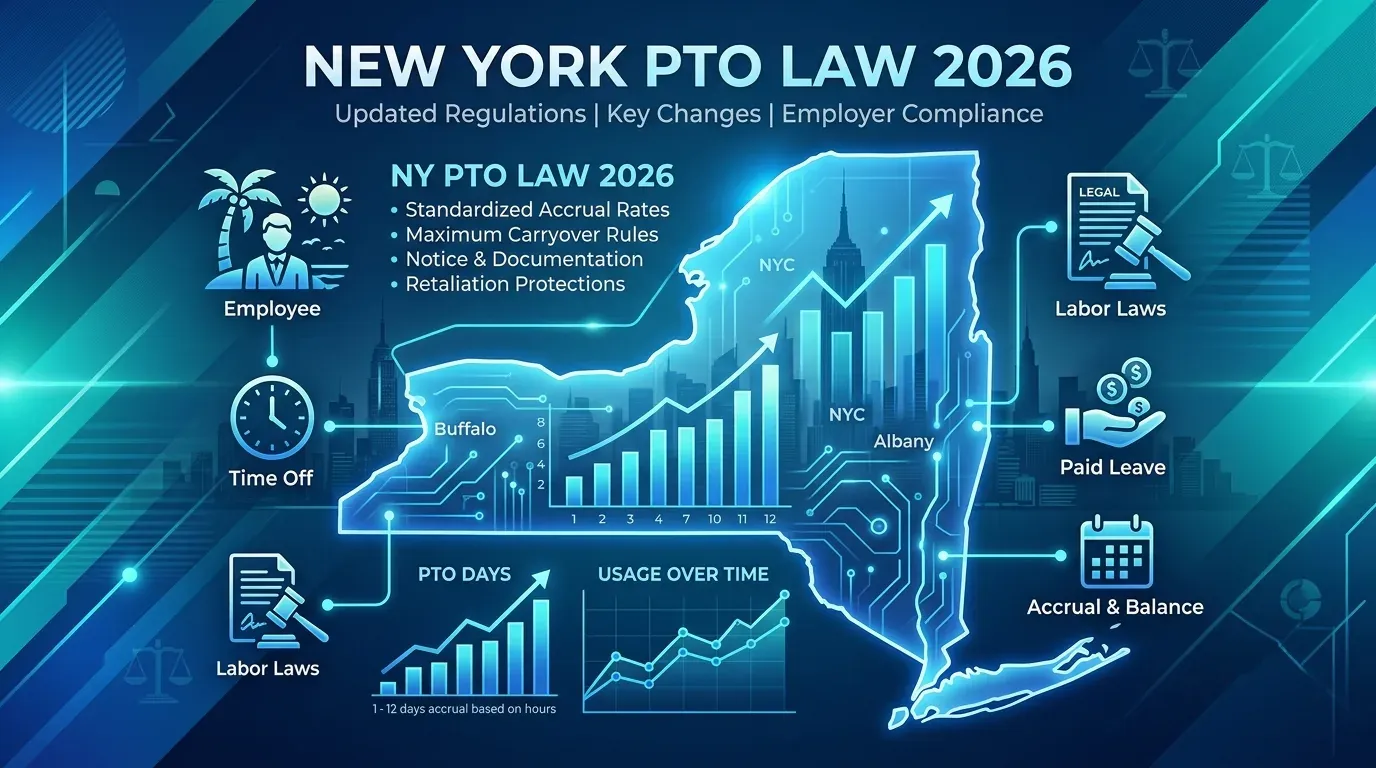
If you work in New York and are changing jobs, retiring, or facing a layoff, check whether your unused PTO must be paid out. The answer depends largely on the employer’s written policy.
New York law gives employers some control over vacation policies, but it also protects accrued benefits. The rules come from N.Y. Labor Law § 198-c and cover use-it-or-lose-it policies, final paycheck deadlines, and how to check whether a payout is due.
The default rule: does New York require PTO payout?
In New York, the default is payment unless a written policy says otherwise.
Under N.Y. Labor Law § 198-c, an employer that agrees to provide benefits or wage supplements, including paid vacation, sick leave, or holiday pay, must pay those benefits at separation.
If an employer offers paid vacation, it must pay accrued, unused hours when an employee leaves unless a pre-existing written policy explicitly forfeits that time at separation.
When the company handbook says nothing about PTO payout, the default is that the employer must pay the employee.
Use-it-or-lose-it and forfeiture rules in New York
A use-it-or-lose-it policy requires an employee to use vacation by a certain date or forfeit it. It can also make payment conditional on an event such as giving two weeks’ notice before leaving.
New York permits these policies only when they meet specific notification requirements:
- Written agreement or policy: The rule must appear in the employee handbook, contract, or another written agreement.
- Prior notification: The employer must have notified the employee in writing before the vacation was earned. A policy introduced mid-year cannot retroactively forfeit hours that were already accrued.
- No retaliation: An employer cannot withhold a PTO payout as punishment unless the relevant condition, such as termination for misconduct, is clearly written in the policy.
If the employer did not give written notice of its forfeiture rules, taking away accrued vacation is illegal.
When is your final paycheck due in New York?
If state law or a contract requires a vacation payout, it belongs in the final paycheck.
New York’s final-pay deadline applies whether the employee resigned, was fired, or was laid off:
- Final pay deadline: The employee must receive all final wages, including accrued benefits, no later than the next regularly scheduled payday after the last day.
An employer cannot delay the final check until a later quarterly cycle or require the employee to wait for a clearance review.
How to calculate a New York PTO payout
If you qualify for a payout, estimate it as follows:
- Find your hourly rate:
- Hourly employees use their standard rate.
- Salaried employees divide annual salary by 2,080. A $65,000 salary equals $31.25 per hour.
- Multiply by accrued hours:
- If you have 80 unused vacation hours, a $31.25 rate produces a $2,500 gross payout.
- Deduct taxes:
- An employer may use 22% federal withholding for eligible separately identified supplemental wages or the aggregate method. The portion above $1 million in annual supplemental wages uses a different rate. Social Security has an annual wage cap; Medicare does not, and Additional Medicare withholding may apply. See IRS Publication 15 and our tax methodology for the assumptions and thresholds.
- State and local withholding also apply. New York state tax withholding uses the state supplemental rate or the employee’s standard withholding brackets.
What to do if your employer refuses to pay
If an employer refuses to pay accrued vacation and has no written forfeiture policy, you can take these steps:
- Contact the NYS Department of Labor: File wage claim form LS223 with the Division of Labor Standards.
- File a lawsuit: For a larger claim, file in small claims or civil court.
- Check the statute of limitations: You have 6 years to file an unpaid wage claim or lawsuit for vacation benefits in New York.
Frequently asked questions
4 questions answered
Yes, unless the employer has a written forfeiture policy. Under N.Y. Labor Law § 198-c, if an employer offers vacation benefits, they must pay unused accrued vacation at separation unless they have a written policy stating otherwise.
Yes, but they are highly restricted. Use-it-or-lose-it is only enforceable if the employer has a clearly written policy that was notified to the employee in writing prior to the accrual of the time.
Whether you quit, are laid off, or are fired, your final paycheck—including any owed wages and PTO payout—must be paid no later than the next regularly scheduled payday.
The statute of limitations for filing an unpaid wage claim or breach of contract claim in New York is 6 years.
About The PTO Payout Research Team
We maintain this independent calculator and document its assumptions and source links. Estimates are informational and are not a payroll service or professional legal or tax review.