Illinois PTO Payout Law (2026): Rules, Final Pay & Employee Rights
Learn Illinois PTO payout laws for 2026. Understand when employers must pay unused vacation, final paycheck deadlines, use-it-or-lose-it rules, and PLAW Act details.
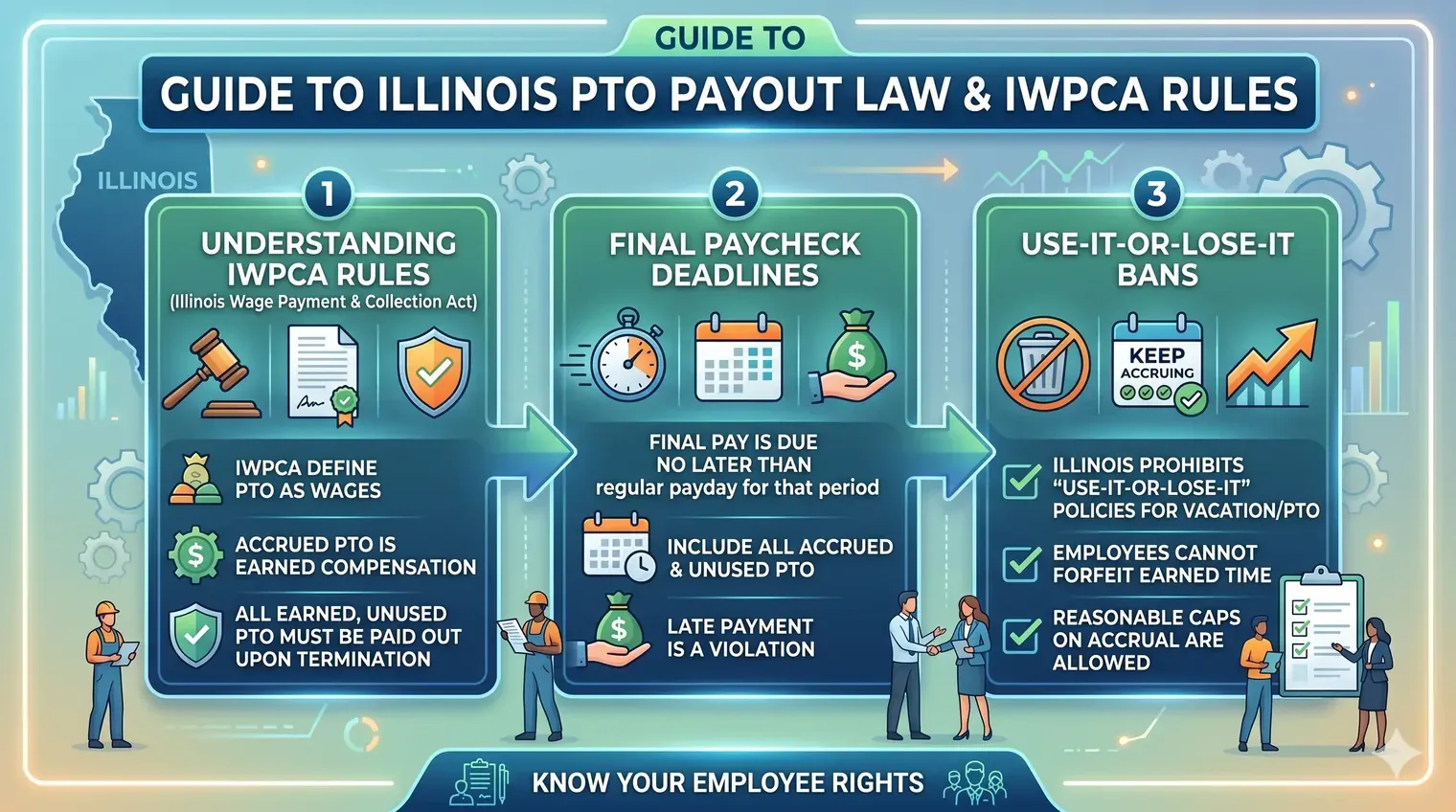
If you are leaving an Illinois job, your unused vacation may be part of your final pay. The reason for leaving does not change the rule: resignation, a layoff, and termination can all require payment for earned vacation.
Illinois treats accrued vacation as earned wages. If an employer provides paid vacation or a combined PTO bank, the employer must pay for every unused hour when employment ends.
Illinois PTO payout law: accrued vacation is earned wages
The main rule for final paychecks in Illinois comes from the Illinois Wage Payment and Collection Act (IWPCA), 820 ILCS 115/5.
When an employer’s policy or contract offers paid vacation, accrued vacation is earned wages under Illinois law and cannot be forfeited upon termination.
The requirements are:
- The reason for separation does not change the rule. Whether you quit with notice, resign on the spot, are laid off, or are fired for cause, your employer must pay out unused vacation.
- A handbook cannot override state law. A policy that says you forfeit accrued PTO for failing to give notice, such as “no two-week notice means no payout,” is illegal in Illinois. The Department of Labor treats vacation as earned wages that cannot be taken away retroactively.
- The payout uses your final hourly wage. If you recently received a raise, the higher rate must be used.
Illinois use-it-or-lose-it vacation: rollover and forfeiture rules
Illinois restricts use-it-or-lose-it policies. An employer cannot make employees forfeit earned time without giving them a reasonable opportunity to use it.
The rules include:
- Forfeitures are prohibited. Because accrued vacation is wages, taking away earned hours is an illegal wage deduction. Unused hours must roll over or be paid out at year-end.
- Employers must provide reasonable opportunities. An employer cannot enforce a rollover deadline unless it can show that employees had ample opportunities to take vacation.
- Accrual caps are allowed. An employer may limit future accrual even though it cannot erase accrued hours. For example, at an 80-hour cap, new accrual stops until the employee uses time and the balance falls below the cap.
Illinois Paid Leave for All Workers Act and PLAWA vs. PTO
Illinois also has a separate leave standard, the Paid Leave for All Workers Act (PLAWA). It requires almost all employers in Illinois to provide up to 40 hours of paid leave per year for any reason.
PLAWA leave earned under the act does not legally require payout at separation, unlike standard vacation time. The exception is a combined PTO bank. If an employer tracks vacation, sick leave, and PLAWA leave together instead of tracking PLAWA separately, the entire balance is subject to the IWPCA and must be paid at separation.
| Leave Type | Purpose | Payout Required at Separation? |
|---|---|---|
| Accrued Vacation | Vacation / General rest | Yes (Required by IWPCA) |
| Combined PTO Bank | Unified leave (Vacation + Sick + PLAWA) | Yes (Required under IWPCA rules) |
| PLAWA Paid Leave | 40-hour State Mandated Leave | No (Unless combined or promised by contract) |
| Paid Sick Leave | Illness / Medical appointments | No (Unless combined in a general bank) |
Final paycheck timelines and late payment penalties
Your employer must pay final wages, including regular pay, commissions, bonuses, and accrued PTO payouts, by the next regularly scheduled payday after termination.
- If the final check is late, unpaid, or missing vacation hours, you can file a wage claim with the Illinois Department of Labor (IDOL).
- You have 3 years from the date the wages were due to file a claim.
- Under the IWPCA, an employer that fails to pay final wages on time may owe the employee the unpaid amount plus a 5% monthly penalty for each month the payment remains outstanding.
How to calculate your Illinois PTO payout
Use this formula to estimate the gross value of accrued vacation:
Gross Payout = Your Unused PTO Hours × Your Final Hourly RateFor salaried employees
To find an hourly equivalent, divide annual base salary by 2,080, which represents 40 hours per week for 52 weeks:
- Salary: $65,000
- Hourly Rate:
$65,000 / 2,080 = $31.25 - Accrued PTO: 80 hours
- Gross Payout:
80 hours × $31.25 = $2,500 Gross
2026 tax withholding rates
For this example, assume eligible flat federal supplemental withholding, Illinois withholding of 4.95%, no other deductions, and wages below the Social Security and Additional Medicare thresholds:
- Federal Supplemental Tax: 22.00%
- Illinois State Income Tax: 4.95%
- FICA (Social Security & Medicare): 7.65%
- Total Withholding Rate: 34.60%
These are example assumptions, not a guaranteed payroll rate. The employer may use the aggregate federal method; annual supplemental wages above $1 million and year-to-date wages can change withholding. See IRS Publication 15. The Illinois PTO Payout Calculator provides an estimate using the documented assumptions.
Frequently asked questions
5 questions answered
Yes. Under the Illinois Wage Payment and Collection Act (IWPCA), accrued vacation is considered earned wages. If your employer offers paid vacation or combined PTO, they must pay you for any accrued, unused time on your final paycheck.
No. Illinois law prohibits use-it-or-lose-it policies that take away already-earned vacation time. However, employers are allowed to set a reasonable cap on how much vacation you can accrue.
No. Under the PLAW Act, general paid leave doesn't have to be paid out when you leave, unless your employer tracks it in a combined vacation/PTO bank or your employment contract promises a payout.
Your employer must pay out your unused vacation wages by your next regularly scheduled payday after you leave the company.
Standard vacation is treated as wages and must be paid out upon separation under the IWPCA. The Illinois Paid Leave for All Workers Act provides up to 40 hours of general leave which does not require payout upon termination unless it is tracked as part of a unified PTO plan.
About The PTO Payout Research Team
We maintain this independent calculator and document its assumptions and source links. Estimates are informational and are not a payroll service or professional legal or tax review.