California PTO Payout Law (2026): Unused Vacation Pay, Final Paychecks & Employee Rights
Learn California PTO payout laws for 2026. Find out when employers must pay unused vacation, final paycheck deadlines, waiting-time penalties, and how to calculate your PTO payout.
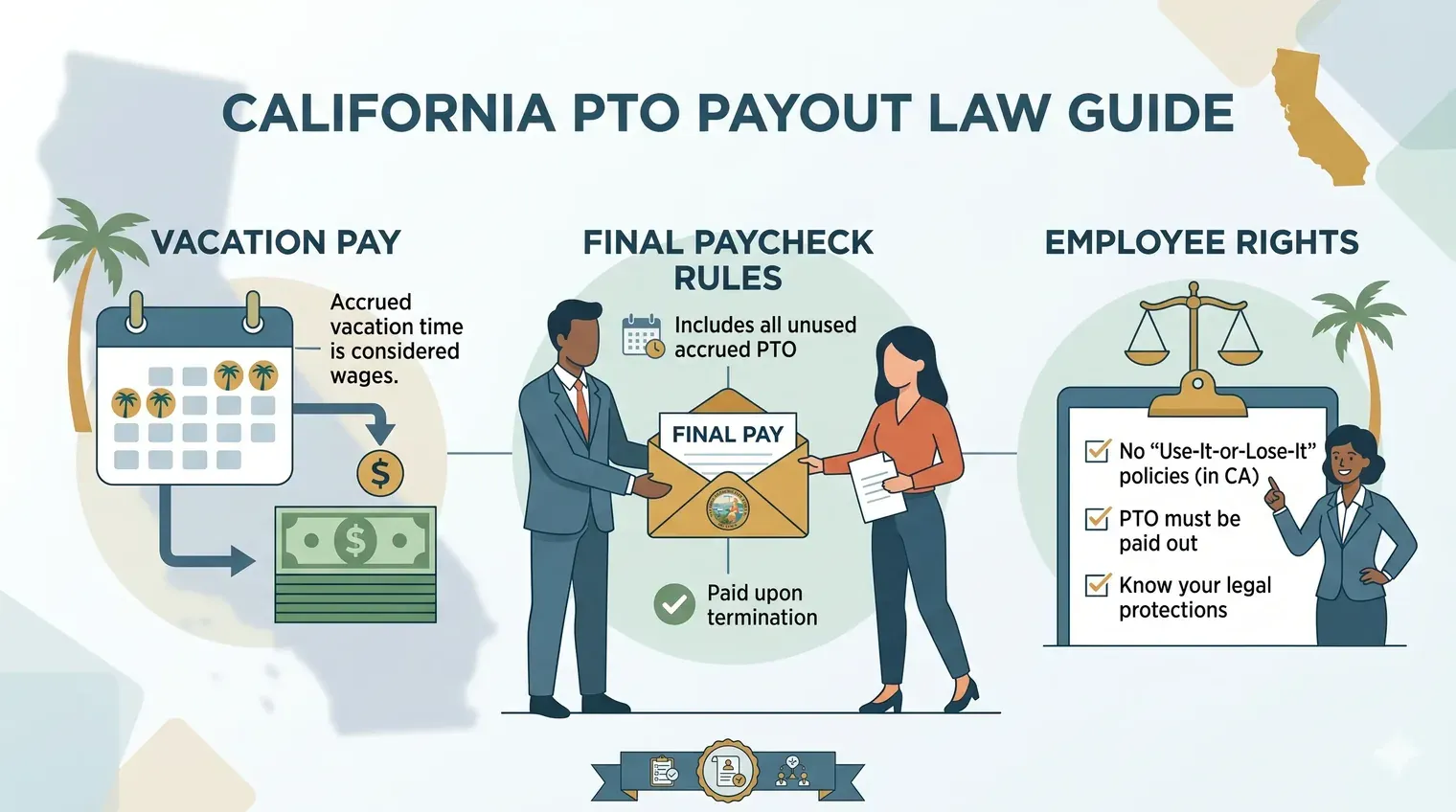
If you work in California, unused vacation time can be part of your final wages. When employment ends, state law may require your employer to pay for each vacation hour you have earned.
California treats accrued vacation as earned compensation, not a discretionary benefit. Employees generally receive payment for unused vacation when they resign, are laid off, or are terminated.
What is PTO payout?
PTO payout is payment for unused paid time off when an employee leaves a company.
In California, earned vacation hours generally become part of an employee’s wages as they accrue. Employers typically cannot take away those hours or refuse to pay them when employment ends.
Depending on the balance and pay rate, a PTO payout can be worth hundreds or thousands of dollars.
California PTO payout law explained
California Labor Code Section 227.3 requires employers to pay employees for earned and unused vacation when employment ends.
The rule applies whether an employee:
- Quits voluntarily
- Resigns with notice
- Is laid off
- Is terminated
- Leaves because of a company restructuring
The payout generally uses the employee’s final rate of pay.
Because accrued vacation is treated as wages, an employer cannot simply cancel the balance when someone leaves.
Why vacation time is considered earned wages
As employees earn vacation hours, those hours gain monetary value. Once earned, they are compensation that belongs to the employee.
That creates two protections:
- Employees cannot lose already-earned vacation through a use-it-or-lose-it policy.
- Employers generally must pay for earned vacation when employment ends.
Are use-it-or-lose-it policies legal in California?
No.
California generally prohibits use-it-or-lose-it vacation policies that make employees forfeit vacation they have already earned.
For example, an employer cannot tell employees:
“Use your vacation by December 31 or lose it.”
When the vacation has been earned, employees generally keep the right to be paid for it.
Employers may, however, use reasonable accrual caps.
Vacation accrual caps in California
Employers cannot erase earned vacation, but they can limit how much vacation an employee may accumulate.
An accrual cap pauses additional vacation earnings after an employee reaches a specified balance.
For example:
| Situation | Result |
|---|---|
| Balance below cap | PTO continues accruing |
| Balance reaches cap | New accrual pauses |
| Employee uses vacation | Accrual resumes |
| Employee leaves company | Entire earned balance is generally paid |
Many employers use caps ranging from 1.5 to 1.75 times the employee’s annual accrual amount.
A cap pauses future accrual. It does not eliminate vacation hours the employee has already earned.
Who qualifies for PTO payout in California?
Most employees who accrue vacation benefits qualify for PTO payout when they leave employment.
Eligibility generally depends on:
- Company vacation policy
- Employment agreement
- Amount of accrued vacation
- PTO program structure
Employees who have earned vacation hours typically have a legal right to payment for those hours when employment ends.
How PTO payout is calculated
California generally requires employers to calculate PTO payouts using the employee’s final rate of pay.
PTO payout formula
Unused PTO Hours × Final Hourly Rate = Gross PTO PayoutExample 1
80 Hours × $30/hour = $2,400Example 2
120 Hours × $35/hour = $4,200A raise received during employment can increase the payout because the calculation generally uses the most recent pay rate.
Final paycheck deadlines in California
California sets strict deadlines for final paychecks. Unused vacation wages generally must be included in that check.
If you are fired or laid off
Final wages are generally due immediately on the last day of work.
If you resign with notice
Employees who give at least 72 hours’ notice generally receive final wages on their last working day.
If you resign without notice
The employer generally has up to 72 hours after the resignation to provide final wages.
| How Employment Ends | PTO Payment Deadline |
|---|---|
| Fired | Same day |
| Laid off | Same day |
| Resignation with 72+ hours notice | Last day worked |
| Resignation without notice | Within 72 hours |
Waiting-time penalties for late PTO payments
An employer that misses the final-pay deadline may owe waiting-time penalties.
Example
Assume an employee earns:
$31.25 per hourWorking an 8-hour day:
$31.25 × 8 = $250 daily wageIf the final paycheck is delayed for 30 days:
$250 × 30 = $7,500 penaltyIn some cases, the penalty may be greater than the unpaid PTO.
What about unlimited PTO?
Some companies offer unlimited PTO instead of tracking a traditional vacation balance.
Under a genuine unlimited PTO program, employees may not accrue vacation hours, so there may be no balance to pay out.
Calling a policy “unlimited” does not by itself eliminate payout obligations. If the policy functions like a traditional vacation plan, employees may still have a right to compensation.
Review the written PTO policy and keep records of approved and denied leave requests.
PTO payout vs. severance pay
PTO payouts and severance pay are different forms of compensation.
PTO payout
- Payment for earned vacation time
- Generally required under California law
- Based on unused accrued hours
Severance pay
- Additional compensation offered by an employer
- Usually based on company policy or agreement
- Not automatically required in most situations
An employee may qualify for both severance pay and a PTO payout.
Is unused sick leave paid out?
California treats sick leave differently from vacation time.
Generally:
- Unused vacation must be paid out.
- Unused sick leave does not need to be paid out.
If an employer combines vacation and sick leave in one PTO bank, different rules may apply.
Review the employer’s PTO policy to see how the benefits are classified.
What to do if your employer refuses to pay PTO
If your employer has not paid earned vacation wages, save these records before filing a claim:
- Save your final pay stubs.
- Download or print PTO balances.
- Review your employee handbook.
- Keep copies of employment agreements.
- Document communications with your employer.
- Consider filing a wage claim with the appropriate California labor agency.
Other wages you may be owed
Unused PTO may be only part of the compensation due when employment ends.
Depending on your compensation structure, you may also be entitled to:
- Earned commissions
- Performance bonuses
- Sales incentives
- Unpaid wages
- Contractually earned compensation
Review your employment agreement and commission plan before leaving a job.
How to file a wage claim in California
If your employer refuses to pay earned vacation at separation:
- Save your final pay stubs and download your PTO balance history.
- Review your employee handbook and any written employment agreements.
- Document all communications with your employer about the payout.
- File a wage claim with the California Labor Commissioner’s Office (DLSE) at (833) 526-4636 or dir.ca.gov/dlse. Keep the records with your claim to support requests for unpaid PTO and any waiting-time penalties.
Frequently asked questions
10 questions answered
Yes. California Labor Code Section 227.3 requires employers to pay employees for all earned and unused vacation time when employment ends — whether you quit, are laid off, or are terminated.
No. California prohibits use-it-or-lose-it policies that cause employees to lose already-earned vacation time. Employers may cap future accrual but cannot erase hours already earned.
Unused PTO hours are multiplied by the employee's final rate of pay. For example, 80 hours × $30/hr = $2,400 gross payout before taxes.
Employers may owe waiting-time penalties equal to one full day of wages for every day the final paycheck is late, up to 30 days. On a $250/day wage, that's up to $7,500 in penalties on top of the unpaid PTO.
Generally no. Unused sick leave does not need to be paid out at separation unless it is combined with vacation time in a unified PTO bank, in which case all hours are treated as earned wages.
In most situations, no. Earned vacation is treated as wages under California law and must be paid when employment ends. Refusing to pay is a wage violation that can be reported to the California Labor Commissioner's Office (DLSE).
PTO payouts are generally taxable wages. Federal withholding may use the optional 22% method for eligible supplemental wages or the aggregate method. California withholding depends on the payment classification and payroll method; the calculator's state rate is illustrative. Social Security and Medicare withholding also depend on year-to-date wages. Withholding is not your final tax liability.
Generally no. California prohibits forfeiture of already-earned vacation. An employer may pause future accrual once you hit a cap, but cannot take away hours you've already earned.
Not always. Vacation and sick leave are treated differently — vacation must be paid out, sick leave generally does not. If your employer uses a combined PTO bank, all hours are treated as vacation wages.
Save your final pay stubs, download your PTO balance records, review your employee handbook, and file a wage claim with the California Labor Commissioner's Office (DLSE) at (833) 526-4636 or dir.ca.gov/dlse/.
About The PTO Payout Research Team
We maintain this independent calculator and document its assumptions and source links. Estimates are informational and are not a payroll service or professional legal or tax review.